
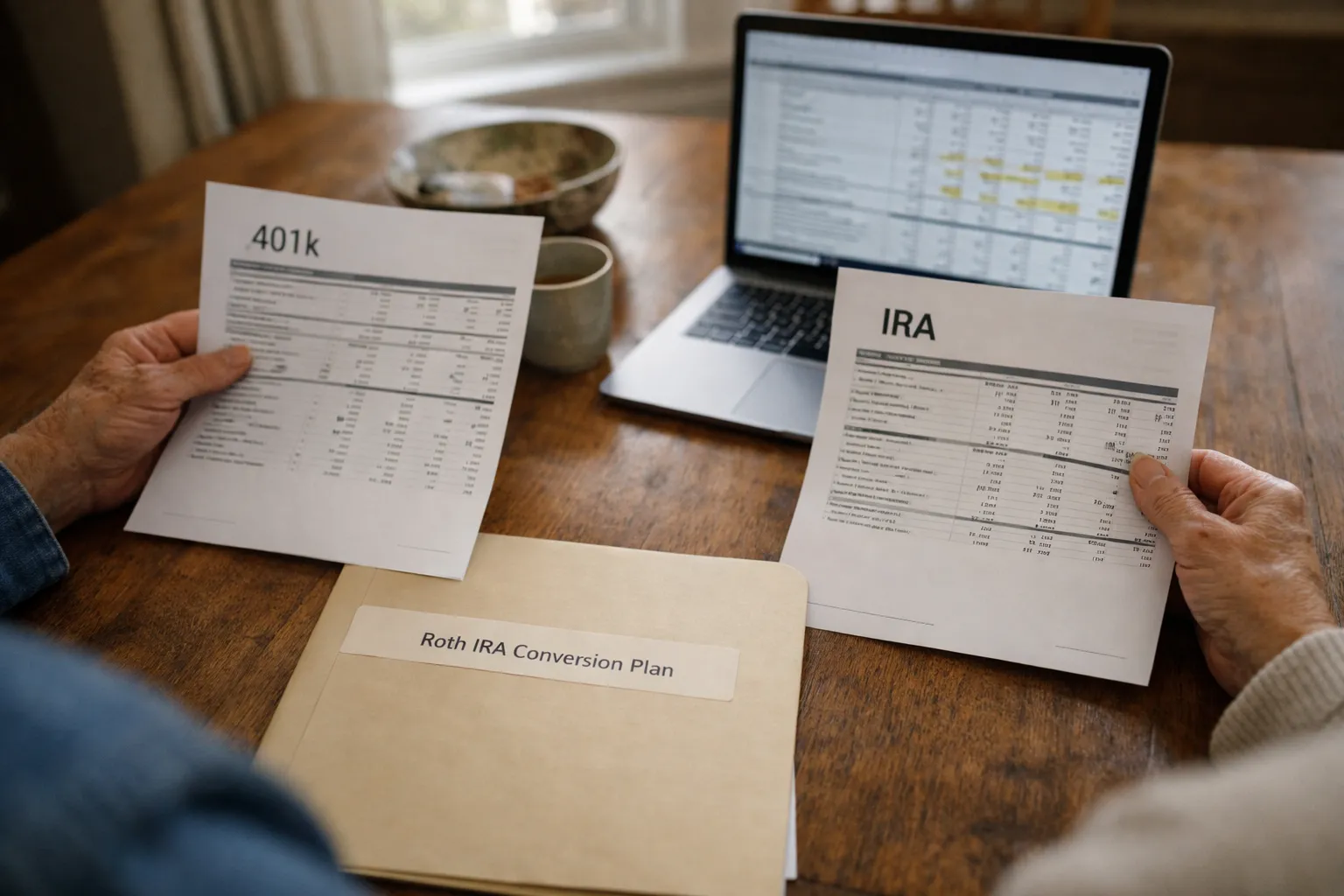
By David Park, Real Estate & Tax Correspondent
Introduction: What you’ll learn—and why this matters in July 2026
If you are within roughly five years of your first required minimum distribution (RMD) or expect major life events in the near term, the conversion choices you make now can materially change lifetime federal and state income taxes, Medicare premiums, and what you leave to heirs. This updated July 2026 guide walks a pragmatic, year‑by‑year Roth conversion plan that coordinates the three levers retirees control: 401(k)/IRA withdrawals, Roth conversions, and Social Security claiming timing—plus rental real estate and the ongoing higher‑rate income environment that many retirees continue to face.
This piece is for retirement planning enthusiasts who want a repeatable planning rhythm, concrete modeling steps, and enough specifics to test scenarios with a CPA or CFP. I focus on things that have shown up in client work through 2024–2026: elevated taxable interest on cash balances, regional divergence in rental markets, continuing Medicare IRMAA sensitivity, and the persistent importance of simplifying inherited retirement accounts for survivors.
Prerequisites and context: What you must confirm before planning
1) Confirm your RMD start year and deadlines
RMD start age and rules have changed in recent legislation and IRS guidance; verify your exact RMD start year on IRS.gov or with your advisor before you finalize conversions. Small differences in start year (for example, whether you take the first RMD by April of the year after you reach the RMD age) can create a year with two RMDs that dramatically reduces conversion room.
2) Inventory every income source and its likely timing
List recurring and one‑off income that will “fill” your brackets: pensions, the Social Security claiming alternatives you’re considering, projected Schedule E rental taxable income, taxable interest and short‑term yield income, dividends, expected capital‑gain realizations from taxable accounts, and any business or consulting income. In 2025–mid‑2026 many retirees report higher taxable interest and short‑term yield income than in prior cycles; include conservative estimates for interest in early modeling.
3) Understand the two hidden costs: Medicare IRMAA & Social Security taxation
Medicare IRMAA surcharges still use a lookback window for Part B/D premium determination. Larger conversions in the two years before Medicare enrollment can raise monthly premiums by hundreds, not just one‑time taxes. Higher MAGI also increases the portion of Social Security subject to income tax (0%–85% under current rules). These effects don’t make conversions wrong, but they must be modeled and budgeted for.
Step 1: Build a five‑year timeline tied to life events
- Across the top of a spreadsheet, list the next five calendar years.
- For each year, add you and your spouse’s ages, Medicare eligibility, and likely Social Security claim ages (best and conservative scenarios).
- Mark known pension start dates, planned work reductions, and any expected taxable events (rental sales, refinancing, trust distributions).
- Note market sensitivity: flag years when you expect lower portfolio values (down markets can create conversion opportunities) or when home sale activity could push AGI higher.
Why: A calendar makes visible clustering risks—an unexpected rental sale or a pension starting the same year you planned a big conversion can consume bracket room. Having the five‑year map turns ad hoc decisions into a coordinated plan.
Step 2: Estimate your “tax‑bracket capacity” each year
For each year, compute projected taxable income before any Roth conversion. Then quantify how much ordinary income you can add before hitting a marginal tax rate or policy threshold you want to avoid (e.g., a higher federal bracket, the IRMAA threshold you don’t want to cross, or the level that materially increases Social Security taxation).
- Pull the prior year’s return to confirm filing status, baseline deductions, and unusual items.
- Project recurring incomes conservatively—treat rental cash flow and interest yields as variable.
- Set a conversion ceiling for each year (for example, convert up to the top of 12% or 22% bracket but stop before a defined IRMAA tier).
Illustrative example (modeling template, not advice): A married couple ages 64/62 expects $60,000 pension + $12,000 taxable interest in 2026. With no Social Security yet and the standard deduction, they may have approximately $30,000–$45,000 of room before hitting the next policy threshold they wish to avoid. If their conversion ceiling is $40,000 in that year, they plan convert that amount in a low‑income year instead of waiting until RMDs begin.
Step 3: Coordinate conversions with Social Security claiming
Delaying Social Security often creates cleaner early conversion years because benefits substantially raise taxable income once claimed. Conversely, claiming early reduces immediate cash‑flow pressure but shrinks conversion capacity.
- Run “claim now vs. delay” illustrations for both spouses using SSA statements and a multi‑scenario tax model (short, median and long lifespans). Prioritize the higher earner’s claim age because it usually controls the survivor benefit.
- If delaying creates multi‑year low‑income windows (commonly ages 62–69), prioritize larger conversions in those years. If you must claim early for cash flow, reduce conversion amounts and move more conversions to years where Medicare lookbacks are less sensitive.
- Model survivor outcomes: conversions that look efficient for two lives can become costly for a single survivor facing future RMDs.
Why: Social Security is both income and tax policy; its timing can amplify or blunt the benefits of conversions.
Step 4: Choose which accounts to convert and in what order
Decide sequence using three criteria:
- Tax efficiency: Convert buckets with the highest expected pre‑tax growth first so tax‑paid compounding inside a Roth has maximum future value.
- Legal/creditor protection: 401(k)s often have stronger creditor protection than IRAs in many states—don’t automatically roll a 401(k) into an IRA simply to convert unless that suits your estate story.
- Liquidity to pay taxes: Prefer paying conversion taxes from taxable accounts rather than from the converted dollars to preserve Roth principal and compounding.
Sequence example: If you have $350,000 in a large traditional IRA and $200,000 in a 401(k) that allows in‑plan Roth, converting the IRA gradually while leaving the 401(k) intact (or using in‑plan conversions later) preserves flexibility and protections.
Step 5: Plan and fund the conversion tax bill
- Estimate federal and state tax on conversions and the likely IRMAA effect. Include these as line items in your retirement cash‑flow model.
- Pay taxes from cash or taxable investments; avoid withholding from the conversion amount when possible—withholding reduces Roth principal and can trigger early‑withdrawal complications if you’re under 59½.
- Use estimated tax payments or safe‑harbor withholding to avoid underpayment penalties; when rental schedules or capital gains make income volatile, quarterly payments are usually the safe route.
Real‑world note: In the higher‑rate environment of 2024–2026, many retirees report sizable short‑term yield income from money market and laddered CDs. That income must be in your baseline before you commit to conversion amounts.
Step 6: Fold rental real estate and depreciation into the plan
Rental depreciation frequently lowers taxable rental income relative to cash flow—this can create conversion capacity while preserving cash for taxes.
- Use Schedule E to determine taxable rental income (not just net cash flow). Confirm passive loss rules and whether you materially participate.
- If you expect to sell a property, model depreciation recapture and capital gains. A sale year often eliminates conversion capacity—plan conversions in adjacent years if possible.
- Consider cost‑segregation early in ownership to accelerate depreciation in years you expect conversion capacity, but run the numbers with your CPA before paying for a study.
Why it matters long term: Converting IRA dollars to a Roth reduces future RMDs and leaves heirs a tax‑free vehicle; real estate passed to heirs typically receives a step‑up in basis (under current law), so deciding which assets to convert versus retain affects estate tax exposure and beneficiary tax outcomes.
Step 7: Make Roth conversions an annual rhythm, not a one‑time bet
- Q1–Q2: Project the year and set a preliminary conversion target based on known income and bracket capacity.
- Q3: Revisit after third‑quarter results—rent issues, realized gains, or a late consulting gig can change capacity.
- Q4: Execute conversions (must be completed by Dec. 31) and finalize estimated tax payments.
- After year‑end: Document the decision, save modeling outputs, and update your five‑year grid.
Why: Markets, rents and life events happen. A down market can be an opportunity—convert when asset values are depressed to lock in lower tax on future growth—but keep guardrails and convert only within modeled capacity.
Common mistakes to avoid
- Converting without modeling Medicare IRMAA two‑year lookback and subsequent premium increases.
- Failing to account for increased taxation of Social Security in conversion years.
- Paying conversion taxes from the conversion itself by default—this reduces Roth principal and long‑term growth.
- Ignoring survivor scenarios—what looks efficient for two lives can be costly for a single survivor facing RMDs.
- Letting an unexpected real estate sale or capital gain eat conversion space because you didn’t update projections mid‑year.
Pro tips (practical and implementable)
- Think in corridors, not a single bracket: Set target bands (for example, convert through the top of X% but below the IRMAA tier you want to avoid).
- Establish guardrails: Pick an absolute annual maximum and have an automatic mid‑year cut if unplanned income shows up.
- Coordinate charitable giving: If you plan large charitable gifts, time itemized deductions to create bracket room in conversion years (and verify current deduction limits with your tax advisor).
- Document the estate story: If easing the survivor’s future tax picture is a motive, write a concise rationale for heirs and the executor explaining the conversion strategy and where key documents live.
- Use in‑plan Roth options where appropriate: In‑plan conversions can simplify administration and preserve plan protections—compare fees and investment options before moving funds to an IRA just to convert.
- Run sensitivity tests: Model conversion years with ±20% changes in rental income and a 10–15% market decline to see whether your plan survives rougher scenarios.
Updated considerations for July 2026
Two practical trends through mid‑2026 that inform planning:
- Regional rental divergence. Some Sun Belt and secondary markets that rebounded during the pandemic show rent stabilization or modest declines, while gateway markets have stronger long‑term demand. If you rely on rental cash flow to pay conversion taxes, stress‑test local vacancy and cap‑rate shifts.
- Elevated safe‑cash yields. Money market and short‑term instruments paid materially higher yields in 2023–2025 versus pre‑2020 norms. That increases taxable interest and can reduce conversion capacity in low‑income years—so account for cash yields when setting ceilings.
These trends change the math but not the framework: build the five‑year grid, model bracket capacity, sequence accounts, and fund the tax bill from non‑converted assets.
FAQ
How much should I convert each year?
There’s no single right amount. Set a bracket corridor (e.g., convert up to the top of the 12% or 22% bracket but stop before an IRMAA tier). Convert the amount that fits inside that corridor after you account for pension, projected rentals, taxable interest and anticipated capital gains. Many retirees convert smaller fixed slices annually—$25k–$75k depending on their incomes and tax bands—rather than large one‑time amounts.
Will converting now hurt my Medicare premiums?
Possibly. Medicare Part B/D IRMAA determination looks at your MAGI in a prior year window. A large conversion two years before Medicare enrollment can raise premiums for at least a year or two. Model the tradeoff: sometimes higher premiums for a couple of years are worth the long‑term tax savings; other times spreading conversions over more years is preferable.
Should I use in‑plan Roth conversions or roll to an IRA first?
Compare protections and costs. In‑plan conversions preserve 401(k) creditor protections in many states, may have lower fees, and avoid paperwork. But IRAs often have more investment choices and conversion flexibility. Don’t move a 401(k) into an IRA solely to convert without weighing legal protections, fees, and the plan’s in‑plan Roth options.
How do conversions affect heirs under current inheritance rules?
Converting reduces a future survivor’s RMD pressure and leaves Roth assets that can grow tax‑free. For non‑spouse beneficiaries who must empty inherited retirement accounts within 10 years under current rules, a Roth conversion can simplify their tax planning because distributions from inherited Roths (if the account meets the holding requirements) are often tax‑free—avoid passing large pre‑tax IRAs to heirs if you can convert strategically.
What if I have a major rental sale planned soon?
Model the sale year carefully. Depreciation recapture and capital gains can materially boost AGI and consume conversion space. If possible, move conversions to the year before or after the sale. If you must convert in the sale year, reduce amounts and run sensitivity tests for IRMAA and Social Security tax effects.
Bottom line: As of July 2026, Roth conversions remain a powerful multi‑year tax tool when used deliberately. Build a five‑year timeline tied to Social Security timing, Medicare lookbacks, and real estate events; convert within pre‑set bracket corridors; fund taxes from non‑retirement sources; and make conversion a yearly disciplined process rather than a one‑time bet. That discipline turns a tactical tax move into durable generational planning.